
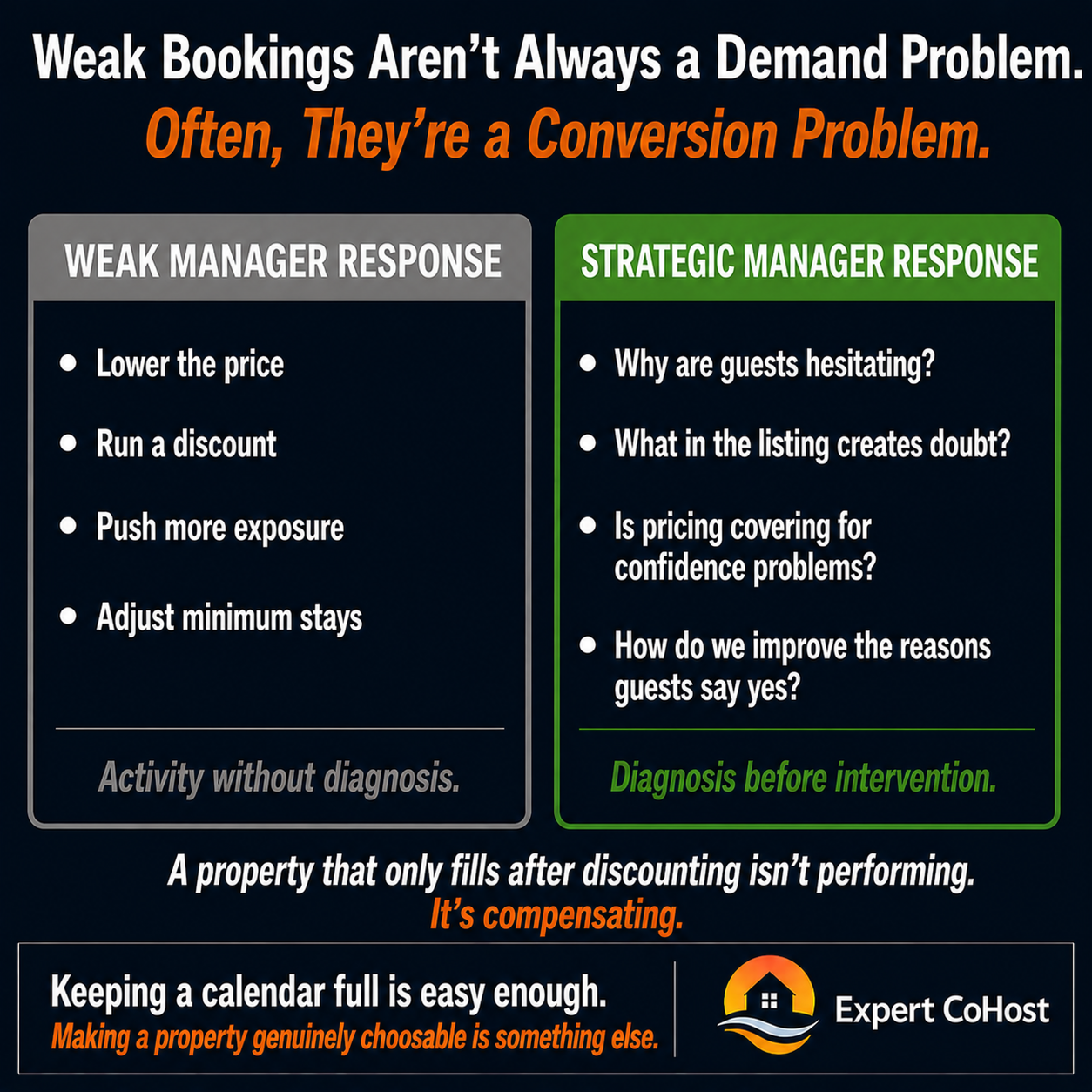
Most Airbnb owners think weak performance starts with weak demand.
Fewer bookings. More pricing pressure. A calendar that needs constant adjustment.
So the conclusion feels obvious: not enough people are seeing the listing.
But that is often the wrong diagnosis.
In many cases, the issue is not visibility first. It is conversion.
The property is being seen. It is just not being chosen often enough.
That distinction matters because it changes the entire conversation. It changes what the problem actually is. And it changes what a strong property manager should be paying attention to.
Conversion Is the Decision Point That Matters Most
On Airbnb, conversion is the moment a guest sees your listing, compares it to nearby alternatives, and decides whether to book.
That decision happens quickly. But it is not shallow.
Guests are not simply comparing price, bedroom count, and whether the photos look nice. They are making a trust decision.
They are asking, often in seconds:
Does this place feel clear?
Does it feel reliable?
Does it feel easy?
Does it feel worth the risk?
That is what many property managers miss.
They treat conversion like a listing metric.
A stronger manager understands that conversion is really a confidence metric.
Visibility Does Not Solve a Confidence Problem
A lot of owners hear some version of the same advice:
“We need more exposure.”
“We need to get in front of more guests.”
“We need stronger traffic.”
Sometimes that is true.
But plenty of listings are already being seen. They are appearing in search. They are entering comparison sets. They are getting their chance.
And then they are losing.
Not because the property is bad.
Because the listing creates hesitation.
This is where owners should pay attention. Weak conversion means demand is touching the property without turning into bookings. The issue is not just reach. The issue is that guests do not feel confident enough to commit.
That is not a narrow marketing problem.
That is a performance problem.
Most Property Managers Misread What Is Actually Happening
When bookings feel softer than expected, many property managers reach for familiar levers:
lower the price
refresh the photos
run discounts
adjust minimum stays
push occupancy harder
Those changes can create movement. But movement is not always improvement.
That is the bigger point.
A weak manager treats conversion like a surface problem.
A stronger manager understands that conversion sits downstream from deeper forces:
- review quality
- expectation alignment
- listing clarity
- communication quality
- perceived ease
- guest trust at the moment of comparison
Those things are harder to see on a dashboard. They are also what usually determine whether a guest books confidently or keeps scrolling.
Guests Do Not Book the Best Listing
They Book the One That Feels Safest to Choose
Owners often assume that if a property is objectively competitive, it should perform accordingly.
Similar location. Similar size. Similar amenities. Similar price.
So if the property looks good, it should get its share of bookings.
But Airbnb does not reward fairness. It rewards confidence. In a winner-take-most marketplace, small differences in trust and clarity can create outsized differences in performance.
Guests choose the listing that feels easiest to say yes to.
Sometimes that confidence comes from stronger reviews.
Sometimes it comes from clearer photos that orient rather than simply impress.
Sometimes it comes from better wording, sharper expectation setting, or fewer unanswered questions.
Two listings can look very similar on paper and perform very differently because one creates less hesitation.
That difference is conversion.
Conversion Starts Before the Stay Does
A lot of property managers think guest experience begins after booking.
That is too late.
Guest experience begins when a guest lands on the listing.
It begins when they scan the photos and imagine arrival.
It begins when they read the description and test whether it feels clear.
It begins when they read reviews for reassurance.
In other words, conversion is shaped by things many managers underestimate:
- how clearly the listing explains the experience
- how accurately the photos set expectations
- whether the house rules are visible early enough
- whether the property feels easy to understand
- whether the tone feels thoughtful rather than generic
- whether the reviews sound enthusiastic rather than merely acceptable
None of that is cosmetic.
It is part of the booking decision itself.
Why Pricing Gets Too Much Credit
Pricing matters.
But pricing is often asked to solve problems it did not create.
When conversion is weak, lowering the rate usually helps. More guests become willing to take a chance. Occupancy improves. The calendar fills faster.
That can make it look like price was the issue all along.
Often, it was not.
The lower price simply compensated for weaker confidence.
In other words, the listing did not become more compelling. It just became cheaper to risk.
Owners should pay attention to that distinction.
A property that converts well at target rates is strong.
A property that only converts after repeated discounting may be active, but it is not healthy.
That is not really pricing strategy.
It is often conversion weakness being covered by lower rates.
What Weak Conversion Usually Looks Like
Conversion problems rarely look dramatic.
That is one reason they are so easy to misread.
The property may still book. Revenue may still come in. Nothing may appear obviously broken.
But the softer signals are usually there:
- bookings happen only after price adjustments
- lead times shrink
- guests feel more price-sensitive
- reviews stay positive, but enthusiasm fades
- performance feels busy, but fragile
- the property needs constant intervention to stay competitive
That pattern matters.
Owners often assume they have a demand problem.
In reality, they often have a selection problem.
Guests are seeing the property. They are simply not choosing it as confidently as they choose stronger alternatives.
This Is Where Average Management Falls Short
Average property management is designed to maintain activity.
Answer messages. Coordinate cleaning. Keep the calendar moving. Adjust rates when needed.
That keeps properties operational.
It does not necessarily make them more choosable.
And that is where owners should pay attention.
Because choosability is what drives compounding performance.
If your property manager cannot explain why guests choose your home over nearby alternatives, clearly and specifically, that should raise questions.
If the answer leans heavily on exposure, software, or dynamic pricing, that may reveal a deeper lack of strategic thinking.
Conversion sits at the intersection of positioning, trust, communication, and guest experience design.
That is what owners should be paying for.
What Stronger Managers Understand
A stronger manager does not reduce conversion to a single metric.
They understand that conversion is built upstream.
It improves when:
- the listing removes ambiguity
- the photos create orientation, not just polish
- the copy answers silent guest questions
- reviews reinforce trust
- expectations are set clearly before booking
- communication feels thoughtful and property-specific
- friction is removed before it becomes visible
Notice what is missing from that list.
More activity.
A lot of property managers confuse activity with performance.
But conversion is not about how much is happening around the listing. It is about how confidently the guest says yes.
That distinction matters.
Why Conversion Matters Even More for Premium Properties
As nightly rates rise, conversion becomes even more important.
Higher-spend guests compare more carefully. They tolerate less ambiguity. They need stronger reassurance before they commit.
At lower price points, some uncertainty can be absorbed by affordability.
At higher price points, uncertainty becomes expensive.
That means larger or premium homes do not just need stronger marketing. They need stronger trust signals. They need to feel worth choosing without resistance.
That is a conversion issue as much as an operational one.
What Owners Should Ask Their Property Manager
If you want to understand whether your property has a conversion problem, ask better questions.
Not:
Are we getting enough views?
Ask:
Why are guests choosing us over nearby alternatives?
Where might guests still hesitate before booking?
What patterns are we seeing in pre-booking questions?
What in the listing builds confidence, and what may still create doubt?
Are we improving the reasons guests say yes, or just lowering price until they do?
How do we know whether performance is being earned or propped up?
Those are better questions because they move the conversation away from surface activity and toward strategic performance.
That is where the real answer usually lives.
The Bigger Point
Airbnb conversion is not a niche marketing concept.
It is one of the clearest windows into whether a property is being managed strategically.
Because conversion tells you something deeper than whether people saw your listing.
It tells you whether they trusted it enough to choose it.
A lot of property managers know how to keep a property live.
Fewer know how to make it compelling.
And in a competitive market, that difference shows up everywhere: in pricing power, booking velocity, review quality, guest quality, and how hard the property has to work to stay full.